
The attic is where most Sand Springs homes win or lose the comfort battle. In July, sun on the roof can drive attic air past 140°F, and in most local homes the air handler and ducts sit right in the middle of that heat. Older homes near downtown and Charles Page Boulevard often have only a few inches of settled insulation, while newer homes on the hills toward Keystone Lake commonly have builder-grade insulation with gaps around every light, vent and wire.
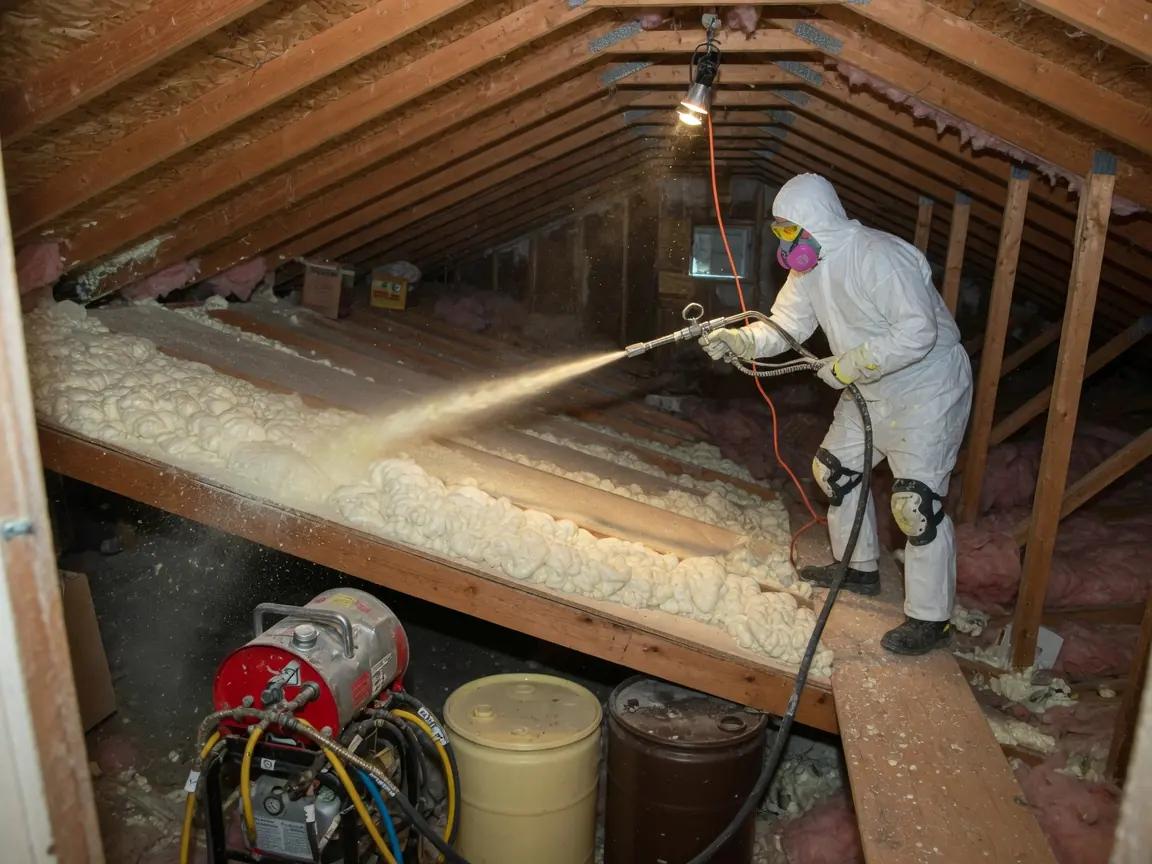
Spray foam on the underside of the roof deck takes the attic out of the extreme-temperature equation. The foam expands to fill every rafter bay, seals the roof deck and gable walls, and creates a semi-conditioned attic that stays near indoor temperature. Your ducts stop soaking up heat, the air conditioner runs shorter cycles, and rooms far from the thermostat stop lagging behind.
Dale Harlan or one of our crew leads inspects every attic before we quote it. We look at decking, ventilation, bath fan exhausts and existing insulation, and we tell you plainly whether roof deck foam, attic floor insulation or a mix makes the most sense. Estimates are free and come in writing.
Sand Springs tip
On shaded, wooded lots west of town, roofs can stay damp longer after storms. We check decking moisture before spraying any roof deck, and we will reschedule rather than spray over wet wood.
Signs Your Attic Needs Spray Foam
- ✓A bedroom or bonus room that stays hot into the evening
- ✓Ducts in the attic that sweat or feel hot to the touch
- ✓Thin or uneven insulation with the joists showing
- ✓Ceiling stains or dust lines near vents and lights
- ✓An AC that struggles on 100°F afternoons
- ✓Drafts from recessed lights or the attic hatch in winter
Choosing Between Open-Cell and Closed-Cell in the Attic
Open-cell spray foam is the usual choice for Sand Springs roof decks. It runs about R-3.5 to R-3.8 per inch, is typically installed 5.5 to 7 inches deep, air seals well and dampens rain and hail noise. It is also the more affordable of the two, at roughly $0.45 to $0.80 per board foot.
Closed-cell spray foam packs about R-6 to R-7 per inch and resists moisture, so we use it in vaulted ceilings with shallow rafters, low-slope roofs and finished attic rooms where every inch counts. If your ducts are not in the attic, insulating the attic floor after air sealing can be the better value, and we will show you that option too.
Attic Spray Foam Insulation Services We Offer
✓Roof Deck Spray Foam
Open-cell or closed-cell foam that creates a sealed, conditioned attic.
✓Vaulted and Cathedral Ceilings
Closed-cell foam where rafters are shallow.
✓Finished Attic Rooms
Foam on knee walls, slopes and gable ends.
✓Insulation Removal
Clearing damp or rodent-damaged insulation before spraying.
✓Ignition Barrier
Code-required coating over exposed attic foam.
Attic Spray Foam Insulation Cost in Sand Springs, OK
| Project | Typical Range | What Affects It |
|---|---|---|
| Roof deck about 1,200 sq ft, open-cell 5.5 in | $3,000–$5,300 | Pitch, access, hips and valleys |
| Roof deck about 1,800 sq ft, open-cell 5.5 in | $4,500–$7,900 | Two-story and larger homes |
| Closed-cell instead of open-cell | Add about 40–100% | R-value per inch, moisture control |
| Old insulation removal | $0.75–$2.00 per sq ft | Depth and contamination |
Planning ranges for Sand Springs homes. Your free estimate gives the exact price after we measure the roof deck.
How It Works
- 1
Inspection
We check decking, ventilation, wiring, ductwork and existing insulation.
- 2
Prep
Living space is protected, vents are sealed as code allows, and damaged insulation is removed if needed.
- 3
Spray
Foam is applied in passes to the planned depth across the roof deck and gable ends.
- 4
Walkthrough
We probe depths with you and clean up.